Available On:


Your Lead Magnet Is Only as Strong as the System Around It
Why Most Coaches Miss the Biggest Piece of the Puzzle
Most coaches put all their energy into creating a beautiful freebie and almost none into what happens before the download and after the download.
Where does this lead?
What should it cause someone to do next?
How do you stay connected with them once they’ve got it?
The truth is, getting the download is just the beginning. The landing page, the thank you page, and the welcome email sequence — those are the pieces that actually do the heavy lifting of turning a curious stranger into a paying client.
Key Takeaway: A mediocre lead magnet with a great system will outperform the most brilliant freebie with no follow-through every single time.
So today, I’m walking you through the full funnel — from the moment someone sees your opt-in offer to the moment they’re ready to say yes to working with you.
Building a Landing Page That Actually Converts
The One Job Your Landing Page Has to Do
Your landing page is the first conversion point in your entire lead magnet system, and it has exactly one job: to get the click. Not to explain your whole business, not to impress anyone — just to get them to fill out that form and download your freebie.
Every element on that page should serve that single purpose.
And yes, even free offers need to be sold.
Everyone’s hard drive is full of things they downloaded and forgot. If people are going to say yes to your freebie, it has to touch them somewhere — they have to feel like they genuinely need it.
What Your High-Converting Landing Page Needs:
- A problem-focused headline. Don’t lead with “Download my free guide.” Lead with the outcome. Something like: “Finally — a simple system for getting more website traffic without posting on social media every single day.” Lead with what’s in it for them, not the format.
- A sub-headline that adds context. One sentence that clarifies who this is for and what they’ll be able to do after they get it.
- 3 to 5 benefit-driven bullet points. Not features — benefits. Not “it’s a downloadable PDF” — but what they’ll know, feel, or be able to do after they use it. Every bullet should connect to something they already want.
- A simple, low-friction opt-in form. I collect first name, last name, and email address — all required. I also include an optional phone number field, because you can do a lot with phone numbers. But don’t make it required, or people will leave.
- A clear, action-language call-to-action button. Don’t just put “Submit.” Use language like “Yes, I Want This!” or “Send It My Way!” You want them mentally saying yes as they click.
- A one-line privacy statement. Something simple like: “I respect your inbox. No spam, ever.” And then live up to it.
What to Leave Off the Landing Page:
Remove the navigation menu, footer links, long backstory paragraphs, and multiple calls to action. You want zero distractions. The moment someone starts wondering if there’s a hidden fee or gets confused about what to do next, you’ve lost them — and a confused mind always leaves.
Landing Pages vs. Pop-Ups: How to Choose the Right One
When a Full Landing Page Is the Right Move
The answer to “landing page or pop-up?” is simpler than most people think — it depends on where your visitor is and how much convincing they need.
Use a full landing page when:
- You’re driving cold traffic from social media, a podcast mention, or a referral. Someone who has never met you needs more context and a dedicated, distraction-free experience.
- Your lead magnet requires explanation — a challenge, mini-course, or webinar that isn’t obvious from a headline alone.
- You’re running paid ads. Ad platforms reward dedicated landing pages with a single focused goal.
- Your freebie has its own URL and you’re sharing it everywhere — it needs a real home.
When a Pop-Up Is the Perfect Choice
Use a pop-up when:
- Your visitor is already on your blog or website and reading your content. They found you organically, they’re already warm, and a well-timed pop-up meets them in that experience without making them leave the page.
- Your lead magnet is a natural extension of the content they’re already reading. If someone is reading your blog post about website traffic and a pop-up offers your free guide on getting more traffic, that’s not an interruption — that’s a gift.
- You want to add value without building a whole new page. Pop-ups are faster to build and easier to test.
The One Rule for Both: Whether you use a landing page or a pop-up, the message has to match. If your blog post is about pricing your coaching services and your pop-up is about website design, it’ll get ignored. Relevance is everything. Your opt-in offer should feel like the obvious next step from whatever brought them there.
Tech Time:
Elementor Pop-Ups
Tool: Elementor (specifically the pop-up builder)
If you’re using WordPress, Elementor is one of the most powerful tools in your toolkit — and I keep coming back to it because it keeps earning its spot. The pop-up builder inside Elementor makes creating opt-in pop-ups incredibly straightforward. You get customizable templates you can tweak to match your branding, full control over when and where the pop-up appears (every page, one specific page, once on the homepage — your choice), and it integrates seamlessly with your lead magnet delivery system.
Key benefits of Elementor pop-ups:
- Easy to use and highly customizable — you can have one ready faster than you think.
- Control over display rules, so you’re not annoying people on every single page.
- Especially effective on blog posts where your lead magnet is a natural extension of the content.
- Template examples built in, so you’re not starting from scratch.
I recommend the Pro version for your business — you need to have a voice when something doesn’t work, and the pro version gives you access to all the features that will actually move the needle. It’s worth the investment.
Find it: Elementor.com or search the WordPress plugin directory.
Your Thank You Page Is Prime Real Estate — Stop Wasting It
The Most Underused Revenue Opportunity in Your Entire Funnel
Here’s something most coaches don’t realize: the person who just opted into your freebie is at peak interest the moment they hit that thank you page. They just said yes. They are more likely to take another action in this moment than at any other point in your relationship with them.
And most coaches send them to a dead-end page that just says, “Thanks! Check your inbox.”
That is one of the biggest missed opportunities in your entire funnel. Your thank you page is prime real estate — just about as important as your homepage.
What Your Thank You Page Should Do:
- Confirm delivery in one sentence. “Your resource is speeding to your inbox right now!” That’s all. Don’t write a paragraph about it.
- Introduce yourself with a little more depth. This is the first time they’ve crossed the threshold into your world. A short 60–90 second video or a warm paragraph that goes just a bit deeper than your landing page helps them feel like they made a great decision.
- Present a tripwire offer. This is where your low-ticket paid offer lives. It must be perfectly aligned with what they just opted in for — not a random upsell, but the logical next step.
What Is a Tripwire and How Do You Price It?
A tripwire is a low-price, high-value offer presented immediately after the opt-in — before the relationship has cooled. Done right, it converts a free subscriber into a paying customer in the same session. While their trust in you is at its highest, while they’re excited — that’s the moment you want to offer them the next win.
Tripwire pricing guidelines:
- Don’t price it under $7. It signals the value isn’t real and barely covers processing fees.
- Don’t price it over $97. At that point, people need more time, more trust, and more social proof before they buy.
- The sweet spot is $17 to $27. Priced for impulse buying — easy enough to say yes without thinking twice, but high enough to signal real value.
What makes a strong tripwire:
- It’s the logical next step after the freebie — not a random product, but the natural continuation.
- It delivers one specific win quickly, just like the lead magnet did.
- It removes a specific objection. Think about what question they’ll have after consuming your freebie — your tripwire answers that question at a price that’s easy to say yes to.
Alignment check before you finalize your thank you page: Ask yourself — does the freebie lead naturally into this offer? Does this offer lead naturally into my signature program or coaching? If both answers are yes, your funnel has integrity — and integrity converts.
The Opt-In Is Not the Goal — The Conversion Is
Why Your Welcome Email Sequence Is Where the Real Work Happens
When someone joins your list, the work of your welcome sequence begins. Getting the download was just the first step. Now your emails have to do the job of building trust, demonstrating your expertise, and making a clear invitation to go deeper.
Many coaches build a beautiful lead magnet with no plan for what to send next. So they send nothing. Or they dump everything they know into the first email and overwhelm their new subscriber. Or they send generic messages that have nothing to do with why that person downloaded the freebie in the first place.
None of that works. Here’s what does.
The 5-Email Welcome Sequence That Builds Trust and Converts
Email 1: Deliver and Delight. Send this immediately after the opt-in. Deliver what you promised, remind them why it matters, and give them one quick win they can act on right away. If they didn’t grab your tripwire on the thank you page, you can mention it briefly here — but keep the focus on delivering value.
Email 2: Your Real Story. This is where you connect. Share a piece of your journey that mirrors where they are right now. Not a highlight reel — a real moment that shows you understand their struggle because you’ve lived it or worked through it with clients just like them.
Email 3: What’s Possible. Paint the picture of what transformation looks like on the other side. Use a client example, a case study, or a specific result you’ve helped someone achieve. Make it concrete — people want to know how many, how much, how long. Know your audience well enough to speak to what success looks like for them specifically.
Email 4: How You Can Help Them. This is the bridge. Connect your expertise to their problem and introduce what working with you looks like. Not a hard sell — a clear, confident explanation of your coaching, products, or services, and who it’s designed for. Because you know exactly why they downloaded that freebie, you can address this pretty directly.
Email 5: The Invitation. Now you make the ask. Invite them to book a discovery call, explore your program, or take whatever the next logical step is. Keep the focus on them and the result they want — not on features and deliverables.
Common Welcome Sequence Mistakes to Avoid
- Waiting too long to send the first email. That first email should go out immediately. If they don’t hear from you within minutes of opting in, you’ve already lost momentum.
- Skipping the relationship-building emails and going straight to the pitch. Trust is what converts — not urgency tactics. Earn the right to make an offer first.
- Writing emails that sound like a newsletter broadcast. Your welcome sequence should feel like a personal conversation, not a mass mailing.
- No clear call to action in each email. Every email should invite them to do something — read a blog post, listen to a podcast episode, join your community. You’re training them on what to do every time they hear from you.
Your Full Lead Magnet Funnel at a Glance
When the whole system is working together, here’s what it looks like:
→ Blog post or social content
→ they discover you
→ they land on your page
→ they opt in
→ they’re taken immediately to the thank you page with the tripwire
→ email one through five goes out
→ email five invites them to a discovery call
→ they become a paying client.
It doesn’t always happen that fast — I’m going to be real with you. Sometimes people aren’t the right fit, or the timing isn’t right for them. But when every piece of your system is doing its job, the path from stranger to client becomes clear, natural, and easy to say yes to. And that is exactly why so many coaches struggle — they have the freebie, but not the system. Now you have both.
Free Download:
Landing Page and Pop-Up Templates
Don’t spend hours building your landing page or pop-up from scratch. Download my free templates — both are ready to customize with your colors and content, and they work with Elementor or directly in WordPress. Just scroll down on the show notes page to grab them.
Client Spotlight:
Theresa Daniel
I first met Theresa in 2023 when she joined the Bestseller Lab, and I’ll be honest — we had a rocky start. But we smoothed it all out and things are going beautifully now. Her book Unstoppable Leaders — a 90-day goal-setting journal focused on overcoming obstacles, developing an unstoppable mindset, and cultivating resilience — hit bestseller status before we even had the chance to promote it. That told me everything: people were already resonating with the content.
Theresa is now organizing her Elevate 2026: The Next Chapter event — a curated leadership experience for women navigating transition, growth, wellness, leadership, purpose, and reinvention. It’s happening October 2nd through 3rd, 2026. More details coming soon!
You can find Unstoppable Leaders in the store at CSICorporation.com or search for it on Amazon.
Congratulations, Theresa — you are such an inspiration!
Coming Up Next
The next episode is going to be a full deep dive into your thank you page strategy. We’ve touched on tripwires today, but there’s an entire episode living inside that one section alone. I’m going to unpack the exact layout, what to say in a welcome video, how to present your tripwire without feeling sales-y, and how to price and position it so it converts in the same session as the opt-in. You do not want to miss it.
—
Support this podcast: https://podcasters.spotify.com/pod/show/unmarketyourbusiness/support
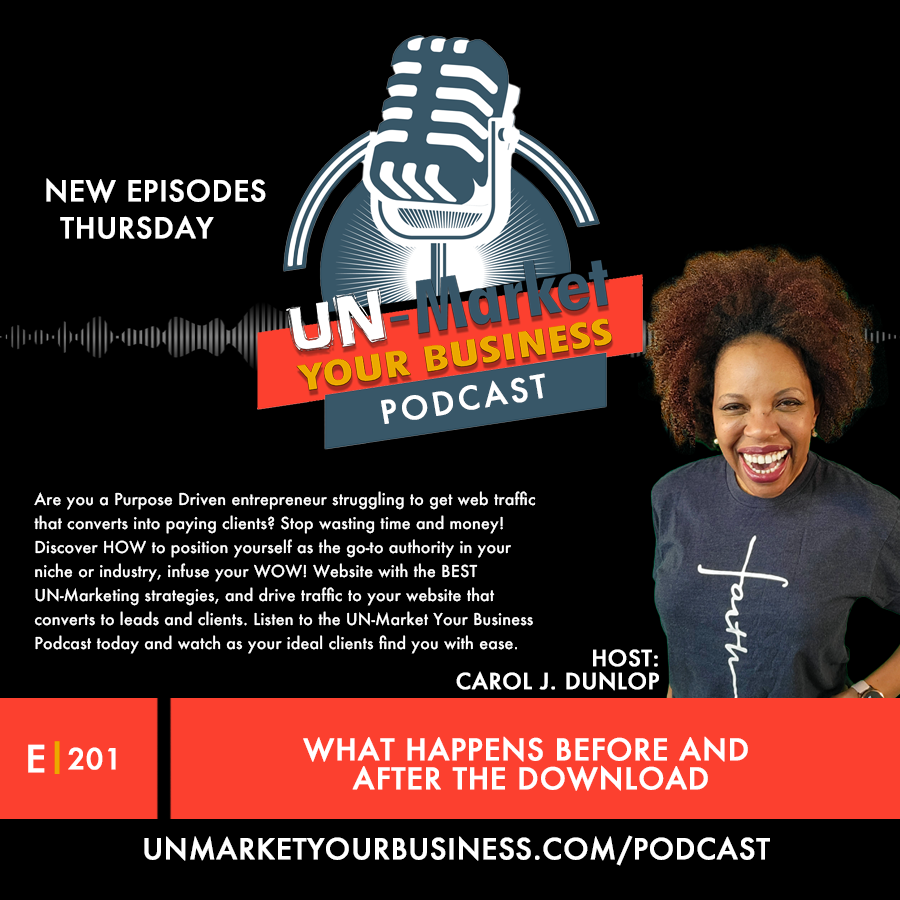
E201:
What Happens Before and After the Download
UN-Market Your Business Podcast
CAROL: Are you a purpose-driven entrepreneur struggling to get web traffic that converts into paying clients? Stop wasting time and money. Discover how to position yourself as the go-to authority in your niche or industry. Infuse your Wow website with the best UN-marketing strategies and drive traffic to your website that converts to leads and clients. Listen to the UN-Market Your Business podcast today and watch as your ideal clients find you with ease.
Let’s head into the studio now with our hostess with the mostess, Carol J. Dunlop.
CAROL: Hey, everyone! How are you? So glad to have you back today for another episode. Now, I’m going to say this right up front — I’m not feeling well. Had some tummy issues, and it’s still kind of bothering me. So if I’m not my usual jumping-off-the-walls self, just bear with me. But I did want to get this episode out to you because it’s really important.
We started something last week with the lead magnet, and I wanted to continue it because all of this is very important to you getting your first or next client. I don’t know how far you are into the lead magnet system. I remember one of my potential clients — I don’t think we ever ended up working together — but she said, “I’m not into that email stuff.” I’m like, what? What are you talking about? You’re not into email, so who are you selling to? How are you finding these people and how are you continuing to sell? Who’s bringing you money? Does somebody have a trainload of clients they’re just sending to you?
Because that’s exactly what email marketing, lead magnets, and this whole complete lead magnet system does for you. It’s like having a string of clients coming in — and you’re bringing the right people, the ones who actually do want to work with you. So that’s what we’re talking about today. I’m pulling back the curtain on the full lead magnet system — not just the freebie itself, but every single page and email that surrounds it.
You’ll discover how to build a landing page that actually converts. You’ll find out my strategy on pop-ups versus full landing pages — when you need them and when you don’t. You’ll learn how to turn your thank you page into a revenue opportunity. And I’m going to give you some hints on your email sequence too. We’ve got a lot going on here, so stick around. Don’t go anywhere.
CAROL: First up — did you know there are only three spots left in the Perfectly Positioned to Soar book? Wow. I remember when I first started talking about it and it was just an idea. Then the first time I put something out there, I got two people. Then more and more. Now there are only three spots left.
So if you’re thinking, “I could be an author” — not just an author, but a bestselling author by this fall — you can do that. You can increase your authority, increase your brand reach, and connect with other bestselling authors. It’s always good to be in a group of people who want the same thing.
I’m doing an interest meeting and you can sign up for it. It’s absolutely free — just a chance to get all your questions answered. Go to UNMarketYourBusiness.com/soar and sign up to attend. Get the information you need, and I’m giving it until Monday, the 18th, to close out. I already have six, maybe seven coauthors, so I’m good. Whatever God blesses me with, I am ready.
CAROL: It’s time for Tech Time!
The technology I’m talking about today — wait, hold up. Don’t say, “Oh my God, is she covering that thing again?” But yes, it is Elementor. And I’m covering it again because Elementor is just that good. In particular, what I’m talking about today are the pop-ups inside Elementor.
Did you know Elementor has a pop-up builder? I think you may be able to access it on the free account, but on the paid account, definitely. They’re easy to use, they’re customizable, and you can set them to show whenever you want. They can show on every page, on just one page — though showing it every time someone turns around is something I don’t recommend. Once on the homepage is usually good enough.
But where pop-ups really come in handy is on your blog. You can do a pop-up there with your value-add lead magnet download. And because we are multifaceted, we’re going to have more than one lead magnet. You don’t operate with just one thing in place. Even with multiple lead magnets, you can still apply the one-one-one system and keep things focused, because you’ve got a lot of content. Especially if you’re over 50 and you’ve been in business for a while — you know a lot of stuff. If you know it, you want to share it. And if you want to share it, you want to get paid for it.
Now, I say go check out Elementor and see if the pop-ups are available on the version you have. Your business requires money, attention, time, and resources — and you don’t want to fool around with a free tool that limits you when things don’t work or when you need improvements. Nothing is worse to me than having a tool where I can’t access all the features I need. With Elementor, it is absolutely worth it to get the Pro version. All the things you’re going to be able to do with it — it’s going to be amazing. So go check it out, and don’t leave because we’re about to get into exactly why you showed up today.
CAROL: What’s holding you back from winning at your marketing? Fear? Imposter syndrome? Frustration? That stops now. What if I showed you how to reach your target audience and get them to buy? How to make social media marketing easy? How to understand the power of email marketing and how to conquer your fear of putting yourself out there?
What if I gave you simple tools and techniques — easy-to-implement training that brings you clarity and gives you the expertise and know-how to convert marketing into money? I’m Carol J. Dunlop, the UN-Marketing Strategist and bestselling author. I teach purpose-driven entrepreneurs just like you to convert marketing into money. If you’re ready to stop allowing fear and frustration to keep you stuck and instead embrace clarity, authority, and expert instruction to convert your marketing strategies into money in the bank, then you need to join the UN-Marketing Academy.
In the Academy, you’ll take a deep dive into the tools, techniques, and training that helped me and my husband sustain a successful business through the 2008 recession, two major health crises, and the pandemic. The Academy is about replacing expensive, frustrating, and overwhelming marketing practices with simple, easy-to-implement resources that get you in front of your target audience and get you paid.
The UN-Marketing Academy is for purpose-driven entrepreneurs who crave simple marketing strategies, coaches who need real-life training to take the overwhelm out of marketing, small business owners ready to conquer their fear of putting themselves out there, service providers who want to use social media and email marketing effectively, and action takers who are ready to go all in. Marketing your business successfully takes work. And without marketing, nobody knows you exist. If you’re ready to convert your marketing into money, join the UN-Marketing Academy today at UNMarketYourBusiness.com/join.
CAROL: All right, you ready? You ready to get into this? I am ready! Let me throw this out to you first.
Your lead magnet is only as strong as the system around it.
I’m going to say that again. Your lead magnet is only as strong as the system around it.
Last week we went into a lot of information about creating your lead magnet, which ones work, and all of that. You spent all that time and put all that wonderfulness into your freebie — and then your delivery mechanism is trash, or how people get it is trash, and you have no follow-up system. We are not trying to do that. Most coaches put all their energy into creating the freebie and almost none into what happens before the download and after the download. Where does this lead? What is this going to cause them to do? How do you connect with them afterwards?
Here’s the truth: a mediocre lead magnet with a great system will outperform a brilliant freebie with no follow-through every single time. Let me say that one more time. A mediocre lead magnet with a great system will outperform a brilliant freebie with no follow-through every single time.
So today I’m walking you through the full funnel — from the moment someone sees your opt-in offer to the moment they’re ready to say yes to working with you.
CAROL: We’ve already talked about the freebie itself, so now we need to talk about the landing page.
This is where the download actually happens. Your landing page is the first conversion point in your lead magnet system, and it has only one job. There’s that word again — one job. To get the click. They see it, they love it, they click, they fill out that short form, they download, and they start doing something. That’s all you can control. But let me show you how to enhance it a little.
Your landing page is not there to impress people or explain your entire business. The only thing you want to talk about on this page is that lead magnet — how awesome it is and why they absolutely need it. Every element on that page should serve that single purpose: getting them to click.
And yes, your freebie is free. You might think, “I’ll just throw it up there — people will grab it because it’s free.” No. Everyone’s hard drive is full of things they downloaded and forgot about. Stuff they’re going to get to in a couple of years. Stuff they already forgot about. People download things because something touches them — because they feel like they genuinely need it. So that’s what we’re going to do. We’re going to make them feel like they need it.
The first thing you need on your high-converting landing page is a headline that speaks directly to the problem. Not “Download my free guide.” Think more like: “Finally — a simple system for getting more website traffic without posting on social media every single day.” Lead with the outcome, not the format. They don’t care what format it is. They want to know: what is this going to help me do? Remember — what’s in it for me?
Next, a sub-headline that adds context. One sentence that clarifies who this is for and what they’ll be able to do after they get it.
You also want a short benefit list — three to five bullets. Not features of the freebie, but what they’ll know, feel, or be able to do after consuming it. Features are: “It’s 8.5 by 11. It’s a PDF. It’s easily downloadable.” Nobody cares about that. What is the outcome they want? That’s what they want to know. Every bullet should connect to something they already want.
Next — a simple, low-friction opt-in form. I collect first name, last name, and email address, all required. I want to know who they are. I also include an optional field for a phone number, because you can do a lot with phone numbers — you can call or text them, or you can use a service like Drop Cowboy to send messages to your whole list. It’s just a few cents per name, and it works well. But keep the phone number optional. People get upset if you try to force it.
The only other thing I add to my opt-in forms — and this is specific to ActiveCampaign, though others may offer it too — is a text permission checkbox. It says something like, “Are you okay with receiving occasional text messages?” If they say yes, great. If they say no, that’s fine too. I don’t text people constantly anyway, but it’s always good to have those alternate ways of reaching them.
Most importantly, you need a clear call-to-action button with action language. Don’t just put “Submit.” Use language like “Yes, I Want This!” or “Send It My Way!” or “Get Instant Access!” I personally love “Yes, I Want This!” because when someone’s reading that button, their brain is saying yes — and that’s exactly where you want them to be. It’s psychological, and you’ve got to work with how people think.
You also want to add a one-line privacy statement. Something simple like: “I respect your inbox. No spam, ever.” And then live up to it. Don’t spam them, don’t sell the list — keep that relationship between you and your subscribers.
And here’s what to leave off the landing page: No navigation menu. No footer links. No long backstory paragraph about you. And only one call to action. You’re not telling them about another program coming up next month or anything else. You don’t want them thinking about anything other than this one thing. The moment someone starts wondering if there’s a hidden fee, or gets confused about what they’re supposed to do — that’s the moment you’ve lost them. A confused mind always leaves.
CAROL: Now let’s talk about pop-ups versus full landing pages and how to choose the right one. This is one of the questions I get a lot, and the answer is actually simpler than you think. It depends on where your visitor already is and how much convincing they need.
Use a full landing page when:
Number one, you’re driving cold traffic. Someone coming from a social media ad, a podcast mention, or a referral who has never met you before — they need more context and a dedicated experience with no distractions. That’s when a landing page really helps them.
Number two, your lead magnet requires explanation. If what you’re giving away is a challenge, a mini-course, a webinar, or anything that isn’t obvious from a headline, a full page gives you room to sell the value.
Number three, you’re running paid ads. Ad platforms reward landing pages that have a single, focused goal, and you want complete control over what someone sees after clicking your ad.
And number four, you’re pitching the lead magnet as a standalone offer. If this freebie has its own URL and you’re sharing it everywhere, it needs a real home — and that home is a landing page.
Use a pop-up when:
Your visitor is already on your blog or website. They found you organically, they’re reading your content, they’re already warm. A well-timed pop-up meets them in the middle of that experience without making them leave the page.
Second, your lead magnet is a natural extension of what they’re already reading. If someone is reading your blog post about website traffic and a pop-up offers your free guide on getting more traffic, that’s not an interruption — that’s a gift. They’re going to say, “Yes, I want more of this!”
Third, you want to add value without building a whole new page. Pop-ups are faster to build, easier to test, and perfect for blog posts that need an opt-in without a full production build.
And finally — you’re using Elementor. That’s exactly why I highlighted it in Tech Time today. Their pop-up builder makes this whole thing really straightforward. They have templates you can tweak and get going fast.
One rule that applies to both a landing page and a pop-up: The message has to match. If your blog post is about pricing your coaching services and your pop-up is about website design, it’ll get ignored. Relevance is everything. Your opt-in offer should feel like the obvious next step from whatever brought them there.
CAROL: Now let’s move on to the thank you page — which is the most underused revenue opportunity in your entire funnel.
Think about it. Your prospect sees your lead magnet. They’re excited. They click. They fill out the form. And then what comes up between the moment they click and the moment they actually get the download? There’s another page — and that page says something like, “Your download is speeding its way to your email inbox. But before you go, you might want to check this out.” That, my friend, is a thank you page that also has a tripwire built right into it.
Here’s why this matters: if you just let them download the thing and you don’t give them any other opportunity to open that virtual wallet — even just a little — you could lose them. Research shows that 30 to 50 percent of people who just opted in will click on something relevant you offer them immediately afterward. As long as the message matches what they’re trying to do, they’ll buy.
Most coaches send people to a generic “Thanks! Check your inbox!” page and call it done. This is one of the biggest missed opportunities in your entire funnel. Your thank you page is prime real estate. It’s just about as important as your homepage. Here’s why: the person who just opted in is at peak interest. They just said yes. They are more likely to take another action in this moment than at any other moment in your relationship with them. And you’re sending them to a dead end.
Here’s what your thank you page needs to do:
First, confirm delivery — but do it in one sentence. “Your resource is speeding to your inbox right now!” That’s it. Not a paragraph.
Second, introduce yourself with a little more depth than you did on the landing page. This is the first time they’ve crossed the threshold into your world. A short 60 to 90 second video, or a warm paragraph that goes just a bit deeper, helps them feel like they made a great decision. You want them pumped up about it — thinking, “Yes, I clicked that button and now this person is welcoming me in. That was the right move.”
Third, introduce a tripwire offer. This is where your low-ticket paid offer lives, and it has to be perfectly aligned with what they just opted in for.
CAROL: Now, what is a tripwire and how do you make sure it’s priced and positioned correctly?
A tripwire is a low-price, high-value offer presented immediately after the opt-in — before the relationship has cooled. Because remember, they’re excited! They just got the thing they wanted. While their trust in you is at its highest, done right, a tripwire converts a free subscriber into a paying customer in the same session.
Think about it: someone came to your site. Maybe they didn’t even know you before — maybe they heard you on a summit or a podcast or saw a social media post they liked. They came, they downloaded the free thing, it’s going to help them with that one thing they need. And then they see this next offer — and it’s very affordable. That’s a tripwire working exactly the way it should.
What makes a strong tripwire:
It’s the logical next step. They got the freebie; the next step is what the tripwire delivers. It has to feel like the natural continuation, not a random upsell. If I’m talking about website traffic strategies and I have a free download on that topic, what could I offer them next? The Academy is $97 a month, so that might be too big a jump right away. But something in the $7 to $47 range — maybe a page template for their website, like an About page, a Services page, or even a Homepage template set up for better traffic — that’s aligned. And when they get that quick win, they’re going to think, “I need the Academy more than ever.” That’s how the funnel builds.
Your tripwire must also deliver a fast and specific win — just like the lead magnet. One problem, one solution, results they can see quickly. It’s not a comprehensive course. It’s not a full coaching program. It’s that next right step.
And finally, it removes a specific objection. Think about what question they’re going to have after they consume your freebie. What is the next logical thing they need to do? Your tripwire answers that question at a price that’s easy to say yes to.
Tripwire pricing guidelines:
Don’t price it under $7. That signals the value isn’t real and barely covers processing fees. Don’t price it over $97 — at that price point, people need more time, more trust, and more social proof before they buy. The sweet spot is $17 to $27. Priced for impulse buying. They just got the lead magnet; they’re excited about you. They see something for $17 or $27 and they’re like, “Yes, I want that too!”
Don’t discount it into the ground, either. If you launched something at $47 and nobody bought, the price probably isn’t the problem. Look at the messaging and the alignment.
Alignment check before you finalize your thank you page: Ask yourself — does the freebie lead naturally into this offer? Does this offer lead naturally into my signature program or coaching? If the answer to both is yes, your funnel has integrity. And integrity converts.
CAROL: Now let’s move on to the next key point, and this is important: the opt-in is not the goal. The conversion is.
When someone is on your list — meaning they’ve gone from a free, floating internet person who doesn’t know anything about you to now being on your email list and getting your messages — the work of your welcome sequence begins. Getting the download was the first step. Now your emails have to do the work of building trust, demonstrating your expertise, and making a clear invitation to go deeper.
And here’s why so many email lists go quiet: there’s no follow-up plan. Many coaches build a beautiful lead magnet and they have no idea what to send next. So they send nothing. Or they dump everything they know into the first email and overwhelm their brand-new subscriber instead of building curiosity. Or they send generic messages that have nothing to do with the problem that made this person download the freebie in the first place — and they lose that connection immediately.
Your welcome sequence isn’t just a polite “Hello, thanks for being here!” It’s not “Hey, you downloaded this — thanks!” and then silence. It’s a structured relationship-building journey with a clear job to do. Each email has a specific purpose, and together they create a natural path from subscriber to paying client.
These are your goals for the welcome sequence — you might want to take some notes:
Number one, confirm that they made the right choice by downloading your freebie. Remind them of the win they’re about to experience.
Number two, introduce who you are in a way that connects your story and your expertise to their specific problem. Remember, at this stage they barely know you. They’re like, “What are you doing? What are you talking about?” You’re still building that connection.
Number three, demonstrate your approach so they understand what makes working with you different from anything else they’ve tried.
Number four, build trust before the ask. Don’t pitch on day one. Earn the right to make an offer.
And number five, make a clear, confident invitation to take the next step — whether that’s a discovery call, a low-ticket offer, or your signature program, if the timing fits.
CAROL: So how many emails should your welcome sequence have, and what do you say in each one?
Usually five. Sometimes I do seven, and it can even go to ten or twelve — like my Website Traffic Strategies for Entrepreneurs sequence, which has about ten emails because there were nine people involved and I needed an intro and an outro section. But about five is the right number for most purposes.
Email number one — Deliver and Delight. Send this immediately after the opt-in. Deliver what you promised. Remind them why it matters and give them one quick win they can act on right away. If they didn’t grab your tripwire on the thank you page, you can mention it briefly here — but keep the focus on delivering value.
Email number two — Your Real Story. This is where you connect. Share a piece of your journey that mirrors where they are right now. Not a highlight reel — a real moment that shows you understand their struggle because you’ve lived it or worked through it with clients just like them.
Email number three — What’s Possible. Paint the picture of what transformation looks like on the other side. Use a client example, a case study, or a specific result you’ve helped someone achieve. Make it concrete, not vague — people want to know how many, how much, how long. They want specifics. And know your audience well enough to know what success means to them. For some people it’s revenue. For people in the faith-driven community, it might be about impact — what difference are they making in people’s lives? Know what moves your people.
Email number four — How You Can Help Them. This is the bridge. You’ve got them hooked on your story, you’ve built up this arc — now you’re building the bridge that takes them from where they are now to where they want to be. This is where you connect your expertise to their problem and introduce what working with you looks like. Not a hard sell — a clear, confident explanation of your coaching, your products or your services, and who it’s designed for. Because you already know exactly why they downloaded that freebie, you can address this pretty directly.
Email number five — The Invitation. Now you make the ask. Invite them to book a discovery call, explore your program, or take whatever the next logical step is. Keep the focus on them and the result they want — not on features and deliverables. And I’ll tell you a little secret: my favorite AI, Claude, can help you write these emails if you’re stuck on how to say it.
CAROL: Now here are some common welcome sequence mistakes that coaches make — and I want you to avoid all of them.
Waiting too long to send the first email. That first email should go out immediately. If they don’t hear from you within minutes of opting in, you’ve already lost momentum. They’re sitting there wondering if they’re actually going to get their download, and they’re moving on to something else.
Let me give you a real-world example. Last week, there was a person running some kind of Spring Fling promotion. One of my clients mentioned it and it was the last day, and they said there was a planner in there I might like. So I went to check it out. First of all, the landing page was confusing. I didn’t know if I was supposed to download something, sign up for something, or what. I eventually joined — or at least I thought I did. I got an invoice, and then I got an email that had nothing to do with the Spring Fling — just all about who this person was. Which, at that moment, I don’t really care. I want my thing. I never got the actual download. So later that day I emailed and asked how to access the files. And they came back with “What files are you talking about?” I was so done. Beautiful page, confusing system, and I never got what I came for. Don’t let that happen to your subscribers.
Skipping the relationship-building emails and going straight to the pitch. Trust is what converts — not urgency tactics. I don’t care how many times you say “this offer ends tomorrow!” If someone isn’t sold that this is for them, they’re not buying. So earn the right to make that offer first.
Writing emails that sound like a newsletter broadcast. Your welcome sequence should feel like a personal conversation, not a mass mailing.
And finally, no clear call to action in each email. Every email should invite them to do something. Not necessarily to buy — but to read a blog post, listen to a podcast episode, join your Facebook group, or engage with you in some way. You have to train your subscribers on what to do every time they hear from you. Every time they see an email from you, they should click on something. That’s how you build an engaged list.
CAROL: Here’s your full lead magnet funnel at a glance — here’s how it all connects when the system is working:
Blog post or social content brings them to your site → they see your opt-in offer → they download the freebie → they’re immediately taken to the thank you page with the tripwire → emails one through five go out → email five invites them to a discovery call → they become a paying client.
Now, I’m going to be real with you — it doesn’t always happen that fast or that cleanly. You can do everything right and some people still won’t buy, because they’re not the right person, or it’s not the right time for them. And that’s okay! We don’t want people who aren’t ready. We want the people who need us, want us, and will pay us. And when every piece of your system is doing its job, the path from stranger to client is clear, natural, and easy to say yes to.
In the end, every piece connects to the next. Every page and every email does a specific job, and none of it works in isolation. That’s exactly why so many coaches struggle — they have the freebie, but not the system. Now you have both.
CAROL: Now, remember I mentioned at the top that I have something for you? I have a free landing page template and a free pop-up template, and I want you to download both of them right now. Just go to the show notes page — if you’re already there, scroll down and you’ll see the download link. It’s ready to use. You can customize it to your colors, plug in your content, and it works with Elementor or directly in WordPress. It’s going to give you a great head start on your lead magnet system. So go download it now and get started making your money, baby!
CAROL: Is your website ready for prime time? When your ideal prospects land on your website, do they see the true professional you are? Or are they greeted by a site that’s not quite ready for prime time?
For 30 years, CSI Corporation has helped coaches and service providers transform their online presence into powerful, client-attracting machines. We don’t just build websites — we create conversion engines that work for you 24/7. Why choose CSI Corporation for your Wow website? We’re experts in authority marketing and we help you convert web visitors into paying clients with our proven UN-marketing strategy. We offer complete protection — we work hard to keep your website safe from hackers and accessible to everyone. And we offer purpose-driven results with custom designs for coaches and service providers who want to make a real impact.
If you’re ready to make an impact with your website, download the free Wow Website Planner today. Inside this planner, you’ll get all the information you need to create your own Wow website — whether you work with us or someone else. You need a website that converts web visitors into paying clients. Go to CSICorporation.com/planner right now and download it for free.
CAROL: My client success story this week is Theresa Daniel. Congratulations, Theresa! I first met Theresa in 2023 when she came in as a student in the Bestseller Lab. She’ll tell you herself — we had a rough start. But we smoothed it all out, and things are going beautifully now.
Her book, Unstoppable Leaders, is a 90-day goal-setting journal that helps you overcome obstacles and achieve your goals. It’s got practical advice, personal anecdotes, and it walks you through identifying limiting beliefs, developing an unstoppable mindset geared toward growth, and cultivating resilience in the face of adversity. And the coauthors she brought into this project — we had to actually trim it down a bit. I think there ended up being eleven, and we brought in one more, but I prefer to keep it at ten or under because sometimes the other contributors don’t end up getting the full credit on Amazon the way they should with larger groups.
But we made it work, and they are all bestselling authors now. And here’s what made it even more exciting: that book hit bestseller before we even had a chance to properly promote it. That told me everything — people were already resonating with the content. I was so excited by that.
Right now, Theresa is putting together Elevate 2026: The Next Chapter — a curated leadership experience for women navigating transition, growth, wellness, leadership, purpose, and reinvention. That’s her thing, motivating and creating leaders, which is exactly why the book is called Unstoppable Leaders. The event is October 2nd through 3rd, 2026, and more details are coming soon.
If you want to learn more about Theresa and pick up her book, go to CSICorporation.com and head to the store. The book is right there, or you can also find Unstoppable Leaders on Amazon.
CAROL: Would you like to be a guest on the UN-Market Your Business podcast? Simple — just go to UNMarketYourBusiness.com/podcast and apply.
Ready for your Client Spotlight moment? All you need to do is be awesome — either as a client, or by letting me know you used the advice you heard here on a previous episode and posting about it on social media. Be sure to tag me at CSI Corporation and use the hashtag #BestUNMarketingStrategy.
CAROL: The challenge I have for you today is to download the landing page and pop-up templates and get your lead magnet system set up, rolling, and bringing in new clients. If you’re on the show notes page, scroll down and look for the download link. If you’re not there yet, go to UNMarketYourBusiness.com/podcast and look for Episode 201.
Now, let me recap what we covered today.
Number one: Your lead magnet is only as strong as the system around it. A mediocre lead magnet with a fantastic system around it wins every time over the most prestigious freebie in the world with no system at all. Let’s put those things together and make everything professional, above board, and designed to get your subscriber that quick win.
Number two: The opt-in is not the goal — the conversion is. You can do everything right and some people will still say “no, that’s okay” and move on. And that’s fine. We don’t want them anyway if they’re not ready. We want the people who need us, want us, and will pay us. And we want everything set up so it’s easy for them to say yes.
Number three: Always include a tripwire on your thank you page. You never know when someone is ready to say yes. Be there so you can capture that moment. Even if it’s just $7 or $17 — that’s more than you had before. And not only that, you just made your first sale to someone who didn’t even know you an hour ago.
Keep those things in mind, do the work, and you will be just fine.
CAROL: Would you like to get free coaching from me? Simple — go to UNMarketYourBusiness.com/podcast.
Now, you know what time it is — time for the book! And what book is better right now than Unstoppable Leaders by Theresa Daniel?
Unstoppable Leaders is a 90-day goal-setting journal that will help you overcome obstacles and achieve your goals. It provides the tools and inspiration you need to become the unstoppable force you were meant to be. Practical advice, personal anecdotes, and a unique process for identifying limiting beliefs, developing an unstoppable mindset geared toward growth, and cultivating resilience in the face of adversity. You can get this book at CSICorporation.com — head to the store — or search for Unstoppable Leaders on Amazon.
CAROL: Coming up next — the next episode is going to be all about what to put on your thank you page to turn a free download into your first sale. We’ve touched on tripwires today, but there’s an entire full episode living inside that one section alone. Coaches need to see the whole thank you page strategy unpacked — the exact layout, what to say in the video, how to present the tripwire without feeling salesy or icky, and how to price and position it so it converts in the same session as the opt-in. You do not want to miss it.
Thank you so much for being here. There are a lot of things you could be doing right now, and you chose to spend this time with me — and I am so grateful. If you found value in this episode, please share it with your people and let them know. A recommendation from you means the world, and it helps tear down that know-like-trust barrier for someone new who might really need this.
And if you feel moved to leave a review, please do — on whatever podcast platform you’re using right now. Thank you, thank you, thank you for being part of this audience and for actually doing the things I talk about. You all are awesome, and I will see you next time. Bye for now!
CAROL: Thank you for listening to the UN-Market Your Business podcast. If there’s something you want to take action on, check out the show notes at UNMarketYourBusiness.com/podcast. Be sure to like and subscribe so you don’t miss a single episode. And please do me a favor — leave a review on whatever platform you use to access this podcast. It really helps us spread the word and get this podcast in front of the entrepreneurs who need it. See you next episode!
UN-Market Your Business Podcast with Carol J. Dunlop UNMarketYourBusiness.com